
Pacemakers Market Overview
The Pacemakers Market was valued at USD 4.76 Billion in 2025 and is projected to reach USD 6.06 Billion by 2032, growing at a CAGR of 3.5% during 2026–2032, with North America holding the largest share.
Primary Drivers
- Rising incidence of arrhythmias and age-related cardiac disorders driving demand for implantable pacemakers.
- Technological advancements including leadless and MRI-compatible pacemakers improving patient outcomes and adoption.
- Growing geriatric population globally increasing the pool of eligible cardiac device patients.
Primary Challenges
- High cost of pacemaker implantation and device pricing limiting access in low-income regions.
- Risk of device-related complications, infections, and battery replacement surgeries.
- Stringent regulatory approval and reimbursement hurdles delaying new product launches.
This report includes a dedicated chapter covering supply chain exposure, export controls, sanctions risk, and regulatory shifts affecting Pacemakers Market.
Pacemakers Market Strategic Outlook
A pacemaker is an electrically-charged medical device that is placed in the chest or abdomen which helps to control heart beat more regularly with the use of electrical pulses. Pacemakers can be temporary or permanent. Temporary pacemakers are used to treat short-term heart problems, such as a slow heartbeat that's caused by a heart attack, heart surgery, or an overdose of medicine while permanent pacemakers are used to control long-term heart rhythm problems.
Growth trajectory, 2026–2032
How this market is covered
Revenue split by type
Revenue by end use
Pacemaker surgery generally is safe. If problems do occur, they may include swelling, bleeding, bruising, or infection in the area where the pacemaker was placed, blood vessel or nerve damage, a collapsed lung, a bad reaction to the medicine used during the procedure. Patient need pacemaker to keep their heart beating properly which helps their body get the blood and oxygen it needs. A pacemaker regulates body’s electrical system, which controls heart rhythm. With each heartbeat, an electrical impulse travels from the top of heart to the bottom, signaling heart’s muscles to contract. A pacemaker can also track and record heartbeat which can help doctor to better understand patient’s arrhythmia (irregular heartbeats ).
Tracking device data and patient health through wireless remote monitoring systems, magnetic resonance imaging (MRI), longer battery life and technology to help reduce pacing requirements to conserve battery power, new data recording functionality to provide more information on patient health and device status and the introduction of single-chamber, transcatheter-delivered, leadless pacemaker systems are technological advancements that are driving this market.
Different forces driving cardiac pacemaker market are the technologically advanced diagnostics, robust insurance for treatment, increasing R&D investments for pacemakers and practical advances taken by different governments. Technological advancements in cardiac pacemakers, such as dynamic pacemaking technology, transitional tissue welding, and microprocessor-controlled devices, have also fueled the market. However, the high cost of pacemakers is a key restraint in the global pacemaker market.
North America is the largest pacemakers market both in terms of volume and revenue in 2025 followed by Europe due to high level of awareness pertaining to the benefits of pacemakers amongst healthcare professionals, high adoption of pacemaker technology, technological advancements in cardiac pacemakers. Asia Pacific is expected to register significant growth over the forecast period due to the high-untapped opportunities, a large pool of patients, improvement in healthcare facilities, supportive government initiatives and increasing investments by manufacturers especially in China and India.
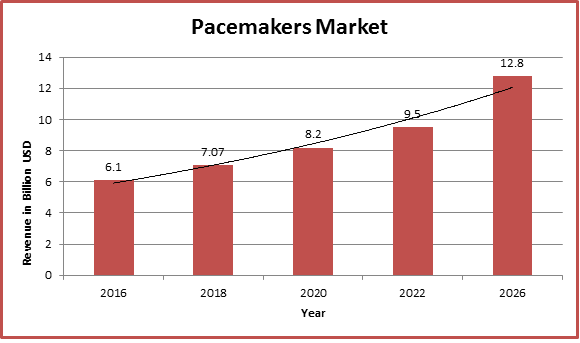
Pacemakers Market Report: Product Type
- Implantable Pacemaker
- External Pacemaker
Pacemakers Market Report: Application
- Hospitals
- Clinics
Pacemakers Market: Competitive Analysis
Report includes accurate analysis of key players with Market Value, Company profile, SWOT analysis. The Study consists of following key players in Global Pacemakers Market:
- Medtronic
- St.Jude Medical
- Cardioelectronica
- Neuroiz
- ZOLL Medical
- Boston Scientific
- Biotronik
- Sorin Group
- Medico
- Vitatron
- Cordis
- CCC Medical Devices
- Izhevsky Mekhanichesky Zavod
- Pacetronix
Geographical analysis of Pacemakers Market:
- North America
- Europe
- China
- Japan
- Southeast Asia
- India
Pacemakers Market Report
Implantable Devices Landscape
Report Coverage
| Parameter | Details |
|---|---|
| Base Year | 2025 |
| Historical Data | 2020 – 2025 |
| Forecast Period | 2026 – 2032 |
| Base Year Value | USD 4.76 Billion |
| Forecast Value | USD 6.06 Billion |
| CAGR | 3.5% |
| Regional Scope | North America · Europe · Asia-Pacific · Latin America · MEA · RoW |
Frequently Asked Questions
Pacemakers Market was valued at USD 4.76 Billion in 2025 and is estimated to reach USD 6.06 Billion by 2032.
Pacemakers Market is projected to grow at a CAGR of 3.5% during 2025–2032.
Pacemakers Market is dominated by the Implantable Pacemaker segment and the North America region holds the highest market share in 2025.
Some of the top key players in the Pacemakers Market are Medtronic plc, BIOTRONIK, Inc, Boston Scientific Corporation, St. Jude Medical, Vitatron Holding B.V, Shree Pacetronix Ltd, Lepu Medical Technology Co Ltd., LivaNova PLC.
1. Rising incidence of arrhythmias and age-related cardiac disorders driving demand for implantable pacemakers. 2. Technological advancements including leadless and MRI-compatible pacemakers improving patient outcomes and adoption. 3. Growing geriatric population globally increasing the pool of eligible cardiac device patients.
Yes. The report includes a dedicated section on geopolitical risk factors and their impact on supply chains, pricing, and regional demand dynamics.